Image credit: Finley Collins for Kyusai
SoulQuest is one of those games you really have to play to understand the appeal. I could talk your ear off about how fun the gameplay is, how charming the visuals are, and how high the overall quality is, but that would do a disservice to the entertainment this game offers. While there are some issues with dialogue and story, overall, it’s a blast.
Developed by TomasJPereyra and published by indie.io, SoulQuest is a side-scrolling hack-and-slash with a focus on big combos and intense visuals. With a variety of special moves and spells, you must make your way through levels and bosses, slaying gods to reunite with your deceased husband.
Flashy and vibrant
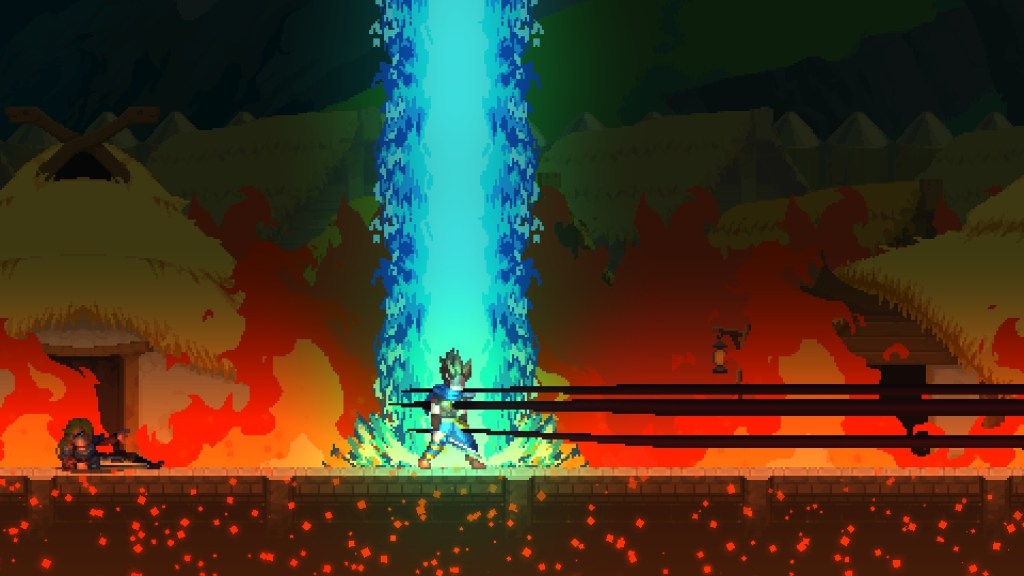
I want to start with the visuals (unlike my usual, more gameplay-focused introductions). I was not expecting the game to lean into a more action-movie-esque presentation in cutscenes and special moves, but it is executed brilliantly.
Every cutscene features an astounding brawl that’ll keep you on the edge of your seat. Paired with some great set pieces, this game has a real knack for making the player feel awesome.
If you enjoy over-the-top action movies or shonen anime, this game will scratch that itch. The pixel art style only works further into this, as the use of colors is remarkable. Alongside some well-defined sprite work, the game never ceases on the graphical side and is incredibly well “directed”.
The music is apt and never gets annoying, even with the amount of time spent in levels. However, there were some issues with dialogue.
The game presents dialogue in text boxes with voice-acted lines accompanying the text. Often, the text did not align with the voice actors’ lines, and one character was not voiced at all. I wouldn’t bother to mention this apart from the fact that I found it odd that only one character, whom you speak to optionally, is not voiced.
Alongside this, the voice acting near the beginning of the game is a little spotty. I think that as the project progressed and the voice actors became more confident in their roles, there was a marked improvement. Much of the more stilted delivery was non-existent in the latter three quarters of the game, but it was still off-putting initially.
That is picking at straws, though, and I may be being too harsh regarding this aspect, especially since the developer is based in Argentina and I played this game in English.
Another big issue within the game is the story. I was pleasantly surprised by some of the game’s moments, especially the choice of protagonist. Her motivations, while a little generic, are believable and lend ample stakes to the game, as well as address heavy themes such as feelings of inadequacy and the loss of a loved one. My issue is with the ending.
I won’t divulge too much, as I wholeheartedly believe this game is great and should be played, but it sort of just ends randomly, leaving many plotlines unfulfilled. There’s even a “Marvel post-credits stinger,” which is bold given that it’s an indie title. While I hope there is a sequel, the open-endedness did feel a little forced.
An intricate dance

The gameplay, oh boy, the gameplay. I loved it, I wasn’t very good at it, but there wasn’t a single combat encounter that I didn’t thoroughly enjoy.
The main point of SoulQuest’s gameplay is to get as large a combo as possible, showcased with the game’s combo rank mechanic, similar to other hack-and-slash games. I think it goes up to the SSSS rank, since that is the highest I’ve reached. Aiming for this in every combat was much of the fun, and you have to make use of a large variety of attacks to achieve this rank.
I played the game on the hardest difficulty available at the start. I thought, given my experience in fast-paced action platformers, I could handle this.
While it was not overly difficult, I did massively underestimate the challenge, especially early on, without the more powerful moves. Later, I fell into repeatedly spamming the same move, but this did not help increase my combo rank.
As such, I started having way more fun when I gave up trying to complete the game and just started trying to look cool. I can wholeheartedly say the title of this review is true: I have never felt as cool as I have playing a game as when truly utilizing every available move in SoulQuest.
The game also becomes significantly easier when you unlock magic and special moves. Three of the four magic spells regenerate your health upon hitting an enemy, with one of them even being able to be held, meaning that at any point, you can reliably regain most of your health.
Alongside the (wonderfully framed) finishers and special moves, these provide even more options within combat to boost your combo and achieve even more intricate strings.
The platforming is quite difficult; however, it becomes much easier when you unlock the air dash and double jump. The game makes a point to say you can use your attacks to bounce off of stage obstacles, but with these two upgrades, that quickly becomes unnecessary.
That is not to say it became a breeze. I would say I died more often to the platforming and stage-specific obstacles than I did to enemies in the late game.
To conclude, as this review is already over a thousand words (and I could keep going), I’d again like to reiterate that this game really needs to be played to be appreciated.
While yes, there are some issues with storytelling, the main gameplay is great. While I’d love it if there were a better ending, I hope this game does well enough to warrant a sequel, as there is so much to love about SoulQuest.
FAQs
The game was developed by TomasJPereyra under the studio title of SoulBlade Studio LLC. Additionally, the game is published by indie.io, which is responsible for several other indie titles, such as Pluto.
SoulQuest’s release date is May 1, 2026.
While SoulQuest is undeniably unique, the developer states that the Devil May Cry and Bayonetta franchises were a major inspiration for the game. However, there is also clear inspiration from other action platformers; the use of attacks to bounce off of stage obstacles reminded me of Hollow Knight.
Depending on how good you are at the platforming and combat, and which difficulty you choose, the game can reliably be beaten in just under four hours for a first-time run. I played it on the hardest difficulty, and it took me about five hours to beat, including completing all 100 stages of the optional challenge run at the end of the game.

About The Author