Image credit: Em Stonham for Kyusai/Siege Wizard Interactive/indie.io
The card-based roguelike genre has become a behemoth over the last few years, with new titles popping up seemingly every day. One of the most unique roguelikes to rear its head in 2026 is Pluto.
Pluto is a dark, psychedelic roguelike that offers a unique spin on the deck-building niche. It follows a wizard in the midst of a jail break, hoping to get to their niece’s birthday party on time – and that’s not even the weirdest thing in the game. Fans of strategic roguelikes will want to dig into this fever dream.
Utterly strange and engrossing

Pluto is one of the strangest roguelikes I’ve had the pleasure of playing in past months – and I’m a massive roguelike geek, so I don’t say that lightly.
The game is a kaleidoscopic experience, placing the player in the shoes of an imprisoned wizard who wants to get to their niece’s birthday party on time.
To get to the party, you’ll need to battle through hordes of strange, psychedelic beasts, casting spells and managing your equipment, all while exploring branching maps and picking up treasures.
Spell-casting in Pluto is rather unique. This is a roguelike deckbuilder, so the spell-casting system is card-based, but it takes place on the wizard’s fingers. Each spell requires a certain number of fingers – a regular spell might take up two fingers, while a powerful one might require both hands.

Each spell has its own elemental affinity. A spell card might be tied to lightning, for example, or fire. These elemental types can be enhanced with the use of magical rings, which are worn by the player’s wizard and help with stat boosts, damage, and elemental power-ups.
To get the most out of your spells, you’ll need to strategically place them, considering blank spaces and overlaps while picking which fingers to use. Blank spaces can be equally valuable; leaving a pinky finger empty might help generate more Shield.
Special conditions can be applied in Pluto, too, with everything from the positive Empowerment, helping spells hit harder, to the bewildering Dizzy, which moves enemies around.
I found combat in Pluto to be incredibly engaging and easy to get into. It’s turn-based, as you might expect, but if you prefer your games to be on the faster side, there’s the option to increase the game speed while fighting.
Something I particularly enjoyed about battles is the curse mechanic. Enemies can temporarily remove a finger or two in Pluto, making it harder to cast more powerful spells. To undo this curse, you’ll need to take a negative effect in return – usually, a chunk of damage will be applied.
Surprisingly beautiful
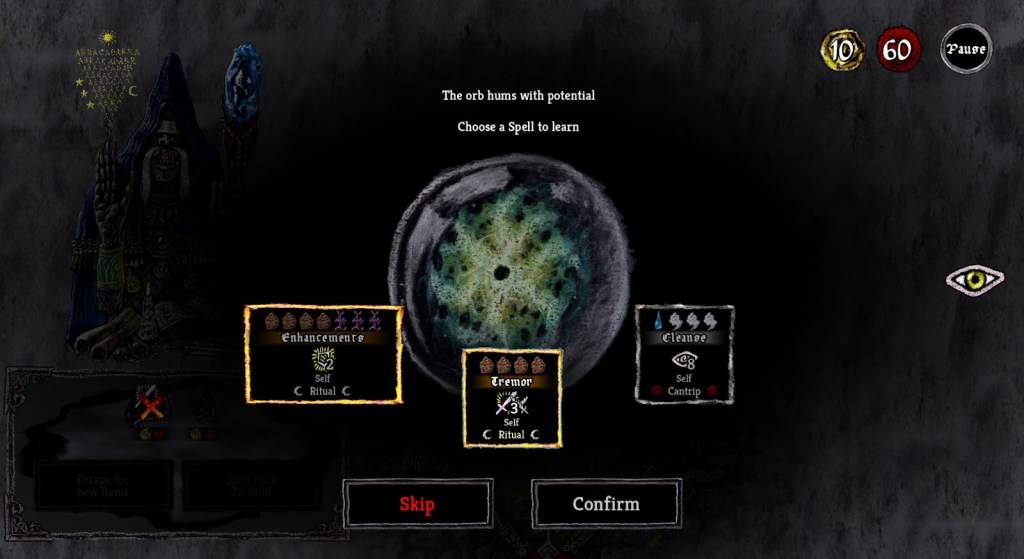
One of the best things about Pluto is that it gives players room to experiment with creative builds and try out weird strategies. You’ll pick up new spells, rings, and badges as you storm through the maps, each with their own unique perks and effects.
I played through a fair few runs while working on this review, and none of them ever felt the same. Sometimes, I’d be rewarded for trying out a new lightning build, for example, and other times, I’d get squished by the first boss due to not understanding how to play my chosen class properly.
Speaking of classes, there are multiple playable wizards in Pluto, which helps to keep the game consistently fun. The two you’ll start with are The Apprentice and The Magus, but more will become available as you make progress, each with a distinctive playstyle.

My favorite thing about Pluto was the art style. It’s deliciously dark and strange, with a visual style that reminds me of oil pastels. Each monster design was beautifully nightmarish, and the interface felt perfectly in line with the game’s theming.
The only minor complaint I have about the visuals is that it wasn’t always easy to see when something had been selected. For example, when choosing three rings to add to my collection on the map, it was sometimes unclear which ring had actually been selected, as the yellow highlight was quite subtle.
It’s not a major issue, though, and overall, I found Pluto to be smooth, approachable, and high-quality. There were no visual quirks or bugs to note from my time with the game.
While the bulk of this review was completed on PC, I also tested it on the Steam Deck. The controls don’t match up exceptionally well to the Steam Deck, but it plays nicely with the touchscreen and still runs well. It’s not flawless on the handheld, but if it’s your preferred platform, it’s playable.
Fans of roguelikes and roguelites with a dark fantasy edge will love Pluto. It’s strange and charming, with a combat system at its core that feels wholly unique.
FAQs
Pluto was developed by Siege Wizard Interactive and published by indie.io.
Pluto is a strategic, deck-building roguelike with a dark, fantastical theme.
No, Pluto is not a horror game. It has some unnerving monster designs, but it’s not scary in the way that a game like ROUTINE is.
The best horror subgenres to look into as a fan include dark fantasy roguelikes – Pluto-adjacent games, essentially – visual novels, sci-horror games, and body horror games.