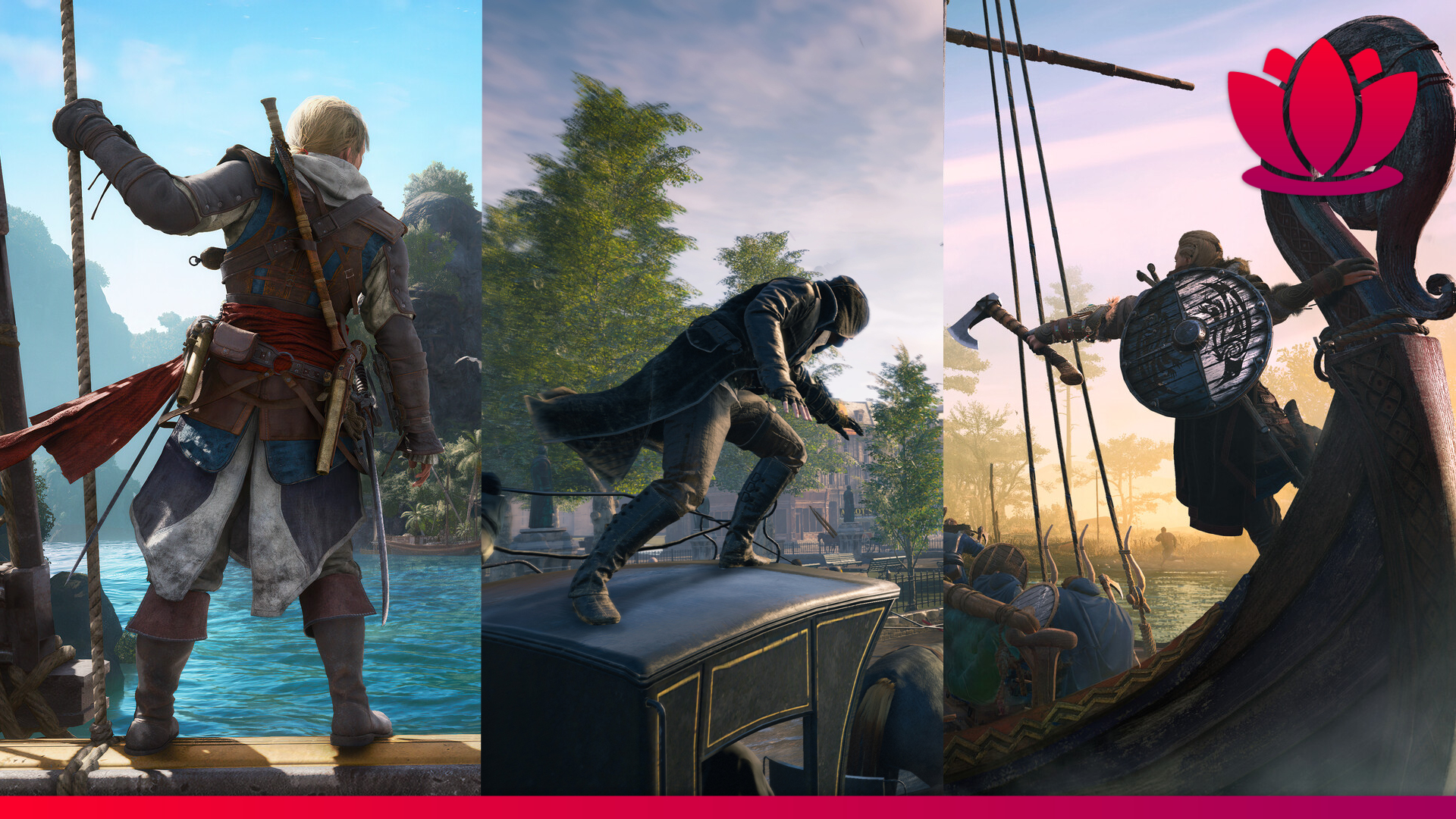
Image credit: Ubisoft
With Black Flag Resynced confirmed for July 9, 2026, interest in the franchise reaches an all-time high. The long-running series spans almost 20 years, with 14 mainline installments and counting, but what’s truly the best Assassin’s Creed game? Not all of Ubisoft’s historical stabbing simulators hold up, after all. I’ve played and finished them all, and can tell you from experience which titles are (and aren’t) worth revisiting nowadays.
The worst Assassin’s Creed games
Let’s not sugarcoat things; some of the Assassin’s Creed games are a waste of time. I’m sticking purely to mainline entries out of respect for your time, and straight away, the immense padding of Assassin’s Creed Valhalla comes to mind. There was a lot going for this Viking-era adventure. Set predominantly in Old England, there was a lot of promise that came from raiding and pillaging as Eivor with the Raven Clan. For the first dozen or so hours, that is.
The biggest problem that Assassin’s Creed Valhalla has is that it refuses to end. You’ll easily spend upwards of 50 hours going through the core narrative if you mainline the story and keep sidequesting to a minimum. If you value a narrative conclusion, however, you’re going to extend your playtime by another 50% or so. That’s because the true ending is locked behind a set of tedious side activities, such as defeating all the Order of the Ancient (Templar) members, as well as their corresponding Zealots (mini-bosses). Fine in theory, sure, but it’s painfully dragged out with fetch quests and repetitive missions to get to that point.
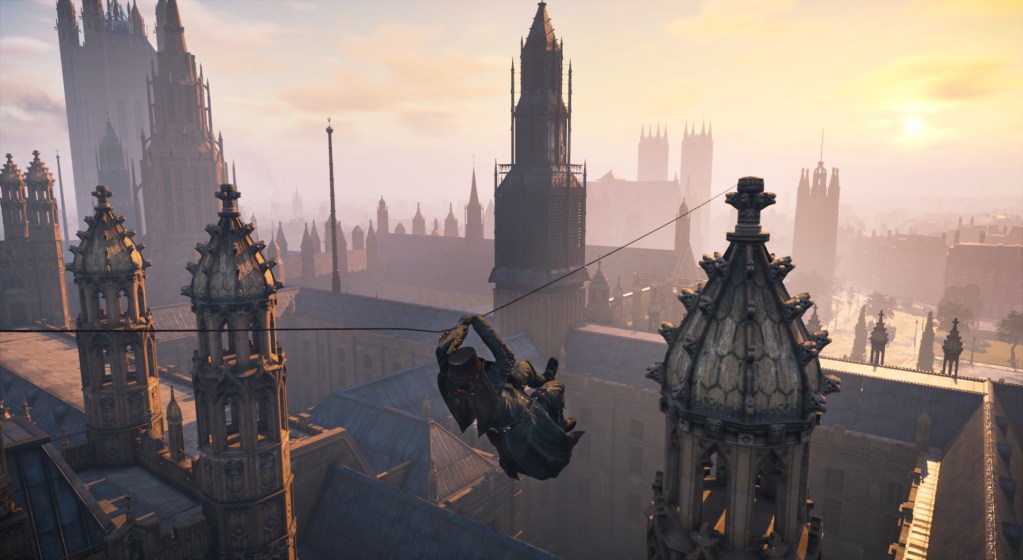
Assassin’s Creed: Syndicate has a similar lack of respect for your time, not to mention some of the worst combat of any open-world game. It should have been perfect: dual protagonists, a stunning Victorian London setting, and the blueprint of Unity to build off, and Ubisoft just couldn’t get the balance right. Terrible writing, spongey enemies, and a complete dilution of the previous game’s black box mission structure make this one challenging to return to. Want to know what’s worse? Artificially halting your progress to make you do literal hours of mandatory “side quests” for Sequence 9, which completely derails the narrative throughline of the story.
While I’m on the subject of disappointing Assassin’s Creed games, Shadows comes to mind. How many years did we all beg and plead for a game set in Feudal Japan, only for Sucker Punch to come along and steal Ubisoft’s thunder with Ghost of Tsushima? Ghost of Yotei would drop mere months after and deliver more of what people actually wanted from a title where you can be a shinobi. Shadows isn’t a bad time by any means; it’s just clunky and disjointed. The dual-protagonist system with Yasuke (a samurai) and Naoe (a ninja) works well enough, but the weak story, poor combat, and lack of a mission structure make this one tough to power through. I bought this game twice, trust me, I tried.
The first Assassin’s Creed game isn’t good either, but it gets an (almost) free pass because it was the start of it all. Set during the Third Crusade, with an interesting look and premise, there’s just enough good ideas to justify its runtime, even if it ends up being incredibly repetitive; get permission to go after a target, eavesdrop on someone, steal some information, get trapped in an unskippable cutscene until you can pounce on your foe. Rinse and repeat for eight to 10 hours. Not one that I can recommend anyone revisit unless you have never played it.
Old Assassin’s Creed games don’t really hold up

I’ve painstakingly ruled out three recent franchise entries, which leaves contenders for the best Assassin’s Creed game, but even that’s remarkably open-ended. Good storytelling (and a healthy dose of nostalgia) would have me lean towards the Ezio Auditore trilogy, released in the late 2000s and into the early 2010s, back when the games industry had the conviction to stick with a character for more than a handful of hours.
As much as I adore Ezio Auditore da Firenze as a character, and love the overarching narrative of his trilogy, actually revisiting Assassin’s Creed II, Brotherhood, or Revelations in 2026 isn’t as pleasant as you may remember. They are all a product of their time, chiefly for how restrictive the mission structure is, how easy the gameplay is, and how half-baked the social stealth really is. All three games tried a cinematic, historical take on Hitman: Blood Money, and it doesn’t quite work as well as you may remember. Nothing really does to be honest: counter everything with the Hidden Blade and effortlessly win every fight. As games, they leave a lot to be desired, okay, but as experiences, they are essential playing.
What about when the opposite is true? That’s what you’re left with when revisiting Assassin’s Creed: Unity. To this day, it features the most fluid parkour, incredible stealth mechanics, challenging combat, and black-box assassination missions that offer multiple entry and exit points, fully respecting player choice and agency. What’s the catch, then? It’s the fact that the narrative is utterly forgettable. Arno Dorian ranks as one of the better assassins to don the robes, but he’s given nothing exciting to do. The French Revolution is a bloody backdrop that’s constantly thrilling and engaging, but the story never fully lives up to its potential.
Speaking of games where the historical background is more interesting than the main narrative, Assassin’s Creed III comes to mind. The revenge story of Conor Kenway hunting down his Templar father, and (accidentally) getting mixed up in the American Revolutionary War, is captivating, even if he isn’t. The experience is bolstered by fluid parkour, brutal combat, and cinematic missions that are actually fun to play. However, there’s one game that struck this balance perfectly, and you’ve probably figured out what it is by now.
What’s the best Assassin’s Creed game?
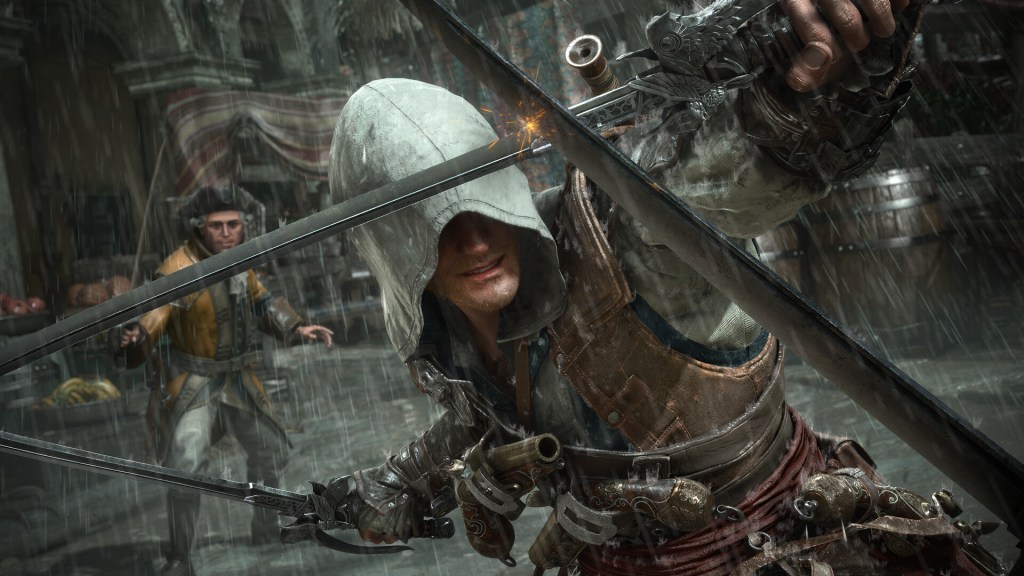
While I’m skeptical of the many changes made to the core experience with Resynced, I cannot fault that Black Flag is the best Assassin’s Creed game. It was only when revisiting the entire series recently that I came to this conclusion, because I certainly didn’t think so when this title was originally released. As I thought about things more, it became clearer. Edward Kenway is a fascinating character, up there with Ezio Auditore. The split experience of sailing around the Caribbean or hunting targets on land kept things fresh and engaging. What’s more, the narrative was sprawling in scope but linear, never dragging. Plus, jumping off the side of a ship, dual cutlasses in hand, never gets old.
Controversial, sure, but with that said, I am still not convinced that Black Flag needed a remake, even after watching Resynced in action. You’re not just getting a graphical facelift here, but Ubisoft has wholly changed how combat works to be more in line with the RPG trilogy of releases, which I can’t say I’m thrilled about. Game remakes can take liberties with the source material if it’s in the service of a better experience, like Resident Evil 4 or Dead Space from 2023, but this version looks to deviate too much. Perhaps my opinion will change come the summer when I get my hands on it, and I’ll read this thinking how wrong I really was. The benefit of hindsight, right?
FAQs
There are two Assassin’s Creed games that take place in Britain, albeit in wildly different time periods. These are: Assassin’s Creed: Syndicate, which is set in Victorian-era London, and Assassin’s Creed Vahalla, which spans the entire breadth of the UK.
Depending on who you ask, the worst Assassin’s Creed game could be Odyssey because it doesn’t follow the typical structure; however, I argue that it’s actually Valhalla because it’s too long, not fun to play, and actively wastes your time.
It’s believed that Assassin’s Creed: Unity is the most difficult title in the franchise for its demanding combat and Splinter Cell-style approach to stealth. You cannot just button-mash through encounters like in the earlier games.

About The Author