Image credit: Illumination; Nintendo
Screen Play, the London Games Festival’s movie and gaming-focused event, hosted what I think was the most interesting discussion of the entire Festival. Simon Pulman is a partner at the Pryor Cashman LLP law firm, which focuses on entertainment and media law, and has extensive inside knowledge of the ongoing negotiations between gaming studios and major Hollywood names.
Pulman had come to deliver a presentation on the current difficulties behind these negotiations, as two different industries struggle to speak the same language. As video games become more valuable and desirable as intellectual property, friction always arises when expectations never seem to meet reality.
Old versus new
Hollywood is an old and ingrained industry that still has very little understanding of what a video game is, and most people involved on the film studio side will never do much research beyond the IP’s name. It’s full of entrenched ideas, with very little leeway outside of its usual standards of practice.
Hollywood still regularly operates by amending a contract with a pen on a hard copy, and then scanning that through, rather than actually amending the base contract. It’s also far more impersonal – there’s a culture of decision by committee.
The most difficult gap to bridge with Hollywood’s expectations is over the rights to the property behind the film.
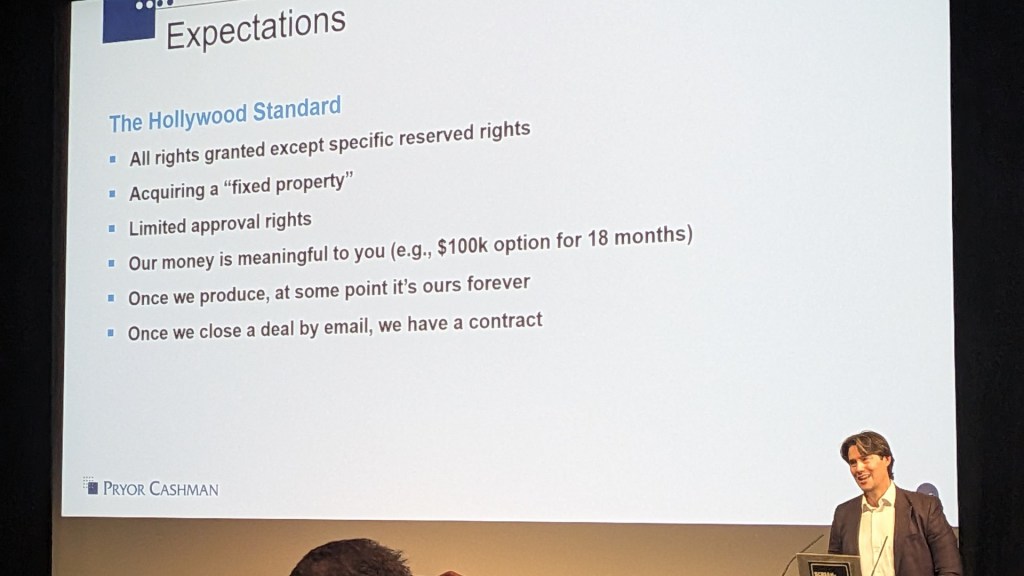
Pulman described the idea of ‘The Hollywood Standard’, that when acquiring a fixed property, all rights are granted to the film studios except specific reserved rights. This means that when they buy the rights to something, they expect to control it from that point forward in perpetuity.
This makes sense in the old school way of acquiring different film properties, where studios would buy the rights to a manuscript or a book, where a single author owns everything, and there’s a fixed story.
The broad expectation that Hollywood will own the property in perpetuity doesn’t make quite the same sense when considering a video game IP, and the difference continues to be a sticking point in negotiations.
As a base standard, when making a film about a video game, Hollywood would broadly expect to own that property in the future. It would be expected to be able to make whatever stories it wanted, and even have the rights to the IP’s merchandise and game distributions.
Film studios also expect the rights to be able to make whatever changes they want to the setting and stories as they like, making original characters that wouldn’t be allowed to be used by the original game studios. According to Pulman, it’s been a long road to get film executives to understand why this expectation is too much for game developers.
Games on the big screen

Games, ultimately, are too complicated to encompass in the Hollywood Standard. According to Pulman, even just trying to define what version of the game and its content can be licensed out can be an absolute pain. Every patch of a game is, technically, a different potential product that has to be included in negotiations.
Not to mention, film studios struggle to understand that, when it comes to video games, they just don’t have any purchasing power.
Pulman used an example where a studio could offer an author 100k USD for the rights to their work, and it would be an excellent deal for the author. For any major game studio, however, this amount of money is a fraction of what they earn in any given month, yet Hollywood would expect to own the property in perpetuity.
To games studios, the main point of making a film would be to drive sales of the games and to tell more stories in that world. In general, the world is a glorified arm of their marketing, and so they’re less inclined to give film executives anything they’d actually want.
Plus, to games studios licensing out their franchise, even just the usual way that films are made in Hollywood, just doesn’t meet their expectations.
Film studios will often buy properties just to sit on them, to have the option to make things if they want, but to be under no pressure if they don’t. To game studios, this is unacceptable, as until there’s a film that’s actually out, they don’t have anything to show for the negotiation.
Working on a compromise

The base expectations and understanding just aren’t there on either side, yet to actually get a film made, they need each other. Hollywood needs access to video game IP, as right now the market is afraid of taking risks, and so is only willing to bank on already established brands.
Game companies also need access to Hollywood’s expertise to make a film of any reasonable scale. This isn’t just a matter of handing the development and production, but also negotiating with the different Film Unions and Guilds that are essential to getting anything done.
Pulman says that progress is happening to help both industries get more things done at the negotiating table. Hollywood is being forced to learn flexibility when it comes to rights negotiations and to what level of creative control they can ultimately exert.
It’s becoming quite common that film studios are being provided with ‘DNA Bibles’, which lay out strict terms as to what they can and can’t do. These are set in place to maintain the integrity of the game’s brand, and can even include mandates on what ratings the films can aim for, or how much flexibility the studio has on a character-by-character basis.
Games studios are also having to understand just how conservative and lumbering the Hollywood machine can sometimes be. Before a film studio can be happy to greenlight a production, they’ll often need a known director and star power in the on-screen talent, which adds ever more arms to negotiations.
These negotiations are huge affairs happening behind closed doors behind some of the biggest media groups in the world, and if either side can’t work out the compromise, then it will inevitably fall through.
The presentation was a fascinating look into a complicated world that, with more game movies on the horizon, could develop a whole new precedent for Hollywood as we advance.
FAQs
Iron Lung, an independent film directed and released by Mark “Markiplier” Fischbach based on the indie horror game of the same name, has a mixed reception among critics but successfully made 52 million from its 3 million dollar budget.
The Super Mario Bros Movie is currently the highest-grossing video game movie, having made 1.3 billion worldwide.
At the moment, the video game movie with the best critical reception is Sonic the Hedgehog 3.