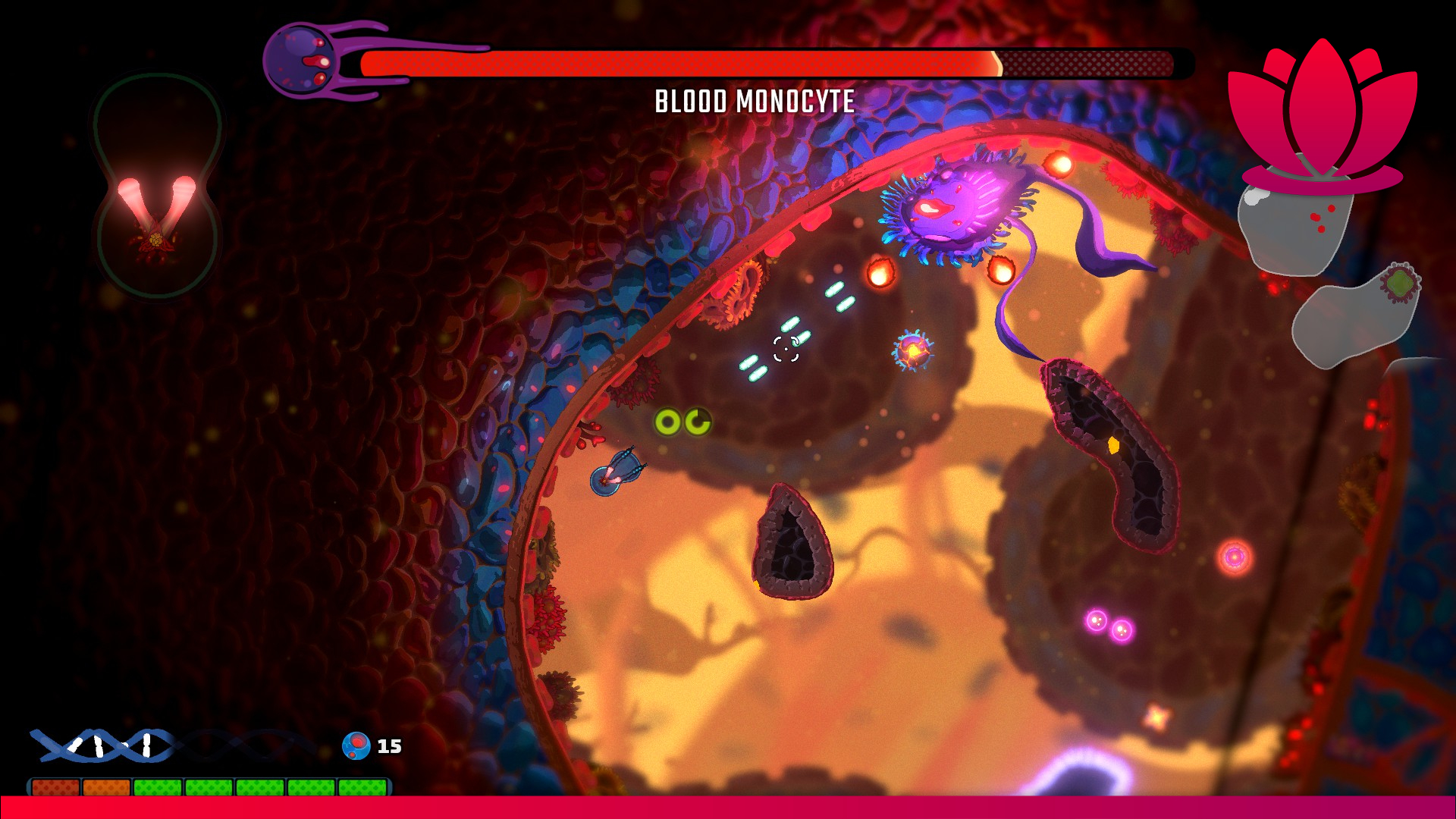
Image credit: Finley Collins for Kyusai / Aberrant Labs / Slug Disco
I have previously covered Pathogenic here on Kyusai. In this brief section, I discussed how I had an established history with both the game and its developers. As such, when its release date was announced, I quickly requested a key, and I am happy to say that I received one.
While that’s all well and good, the main point of these introductory lines is to inform you that I have been playing this game for months at this point. With that, this review may get quite specifically nitpicky, but that is simply because of the hours I have sunk into the game and what I have noticed within that time. For a more microscopic analysis of this twin-stick shooter, here is Kyusai’s full Pathogenic review.
The body is a battlefield

Pathogenic’s gameplay falls under the “twin-stick shooter” category of games. Combined with some strong rogue-like elements and difficult progression, every round will feel like an uphill battle.
When the demo first arrived for the game, I was very much a mouse and keyboard purist. While the mouse and keyboard controls are very good, with the precise movement and dodges feeling great, a controller is definitely the way to play. The complex manoeuvres, mixed with the shooting, make every room its own unique challenge. Pair this with the game’s fast travel feature, something very unusual for a game like this, and this is an incredibly fast-paced and vivid game.
Down to brass tacks now, the game follows your evolving pathogen as it shoots and slashes its way through a human body. After some very well-polished gameplay, clearing rooms, gaining upgrades, and using different weapons, you will reach the boss of the stage. After you defeat the boss of any given stage, you will progress further into the body through each of the vital organs, with new enemies in each organ.
The enemy variety is somewhat lacking, as after a while, it is just seeing many of the same enemies with higher health bars. But, most notably, because of the different stages (such as the intestines being a straight line with branching rooms). These different stages utilise the differently sized rooms to great effect. Although many enemies act similarly, the differently sized rooms allow for major visual and minor gameplay differences.
Additionally, the upgrade system in this game is one of the most in-depth I’ve seen in a long time. You have the standard upgrades; as you play, you will gain “DNA”; collect enough, and you will “evolve” and gain a passive and permanent upgrade. But there are also the “internal and external organ slots”.
The internal slots are used to store items that grant passives to the external slots, which store weapons or movement organelles. There are also internal organs that provide active abilities triggered by a button input.
The level of variety this upgrade system provides is so immense that I could not possibly describe the number of combos and abilities available. Paired with the variety of starting pathogens, all of which have interesting gimmicks, there is no one better strategy than any other. It sort of reminds me of that old browser game Captain Forever (deep cut?), but with a much richer progression system.
Overall, incredibly fun and challenging gameplay. I feel like this may sound hyperbolic, but I genuinely struggle to think of a game with the level of customisation and variety that Pathogenic manages to cram into its relatively simple gameplay.
Real biology isn’t this pretty

Firstly, I’m glad this game has a “disable live-action cutscenes” setting. While I don’t hate them, I do prefer them without. They tend to make the game, for lack of a better term, “goofier”. That aside, though, the presentation of the game is fantastic.
We’ll start with the music, which is amazing. Every level has a suitable soundtrack that flows into gameplay very well. When you’re shopping and upgrading, a calmer, mellower tune will play. Whereas if you’re in combat, a more intense track will start. Par for the course, really, but the music really is great. The dev was actually one of the soundtrack composers for Brotato, and it’s clear they have a great understanding of appropriate music for this style of game.
Similarly, the art style for the game is supremely harmonious with the gameplay. The bright colors and clearly defined sprites make for some incredibly fun targets. I did occasionally find myself struggling to discern between what was an enemy and what was a stage obstacle; however, these issues are not exactly game-ruining. While, as mentioned previously, I would’ve loved some further enemy variety, what is on show is more than sufficient to have several hundred playthroughs, each unique.
Essentially, most of what I have to praise the game for comes down to the incredibly well-thought-out gameplay and general premise of the game. However, what gripes I do have can easily be explained away with the same reasoning as to why I believe the game has such a defined style: the small team. I wholeheartedly believe that if the dev(s) had more resources and a larger team, the issues I presented would be nonexistent. But similarly, perhaps the game would not have the same feeling of sheer creative acumen behind it.
All of this is to say, Pathogenic is a fantastically fun twin-stick shooter, and any fan of the genre or rogue-likes will likely have an immensely fun time playing it. There is no story to be seen outside of the live-action cutscenes (which I disabled), but that does not take away from the game, as truly, the content on show is dangerously addictive. One could almost say, infectious.
FAQs
Pathogenic will be released on July 16, 2026. The demo will become unavailable soon, so if you want to try before you buy, the window is closing.
Pathogenic was developed by Aberrant Labs and published by Slug Disco. Aberrant Labs is the name of the studio founded by Matt, the dev of Pathogenic. He was assisted with the project by J. Roberto, both of whom did a fantastic job.
Matt has previously worked on the soundtrack for Brotato; however, he has only recently fully founded his own studio and has been working on Pathogenic for the better part of a year and a half.
Given the immense amount of customization and variety in Pathogenic, I’m not afraid to say I have no idea whether there is a “best build”. However, anything that attacks multiple enemies seems the most universally effective.