
Image credit: IO Interactive
It’s hard to believe it’s been half a decade since the last James Bond film, and double that long since the storied M16 agent last appeared in the medium of video games. Enter IO Interactive, the famous development team behind the lauded Hitman series, and just the right crowd to resurrect this super spy for a new generation. Kyusai’s full 007 First Light review goes over exactly what makes the new Bond origin story worth experiencing, and touches on some of its rougher edges, too.
The name’s Bond… James Bond
Let’s get the most obvious observation out of the way promptly. 007 First Light isn’t just a James Bond-flavored take on the Hitman series. Instead, the Danish studio has smartly reimagined its core formula, incorporating elements from the Uncharted series and Ubisoft’s Watch Dogs to deliver a thrilling, cinematic story all its own. You’ll be driving, shooting, and puzzle-solving far more than you will be marking your targets for elimination; it’s all quite encompassing and comes together remarkably well.
A key strength of 007 First Light as an origin story is just how long we spend with James Bond himself. As a video game, we get about 10 times the screen time we would have in an Eon production. Dublin’s own Patrick Gibson dutifully inhabits the role of a younger, more naive Bond. The story begins with him as an Aircrewman in crisis who inadvertently finds himself tangled up with M16; it’s the furthest back that only the media has gone, more so than 2006’s Casino Royale with Daniel Craig, which itself is now two decades old.
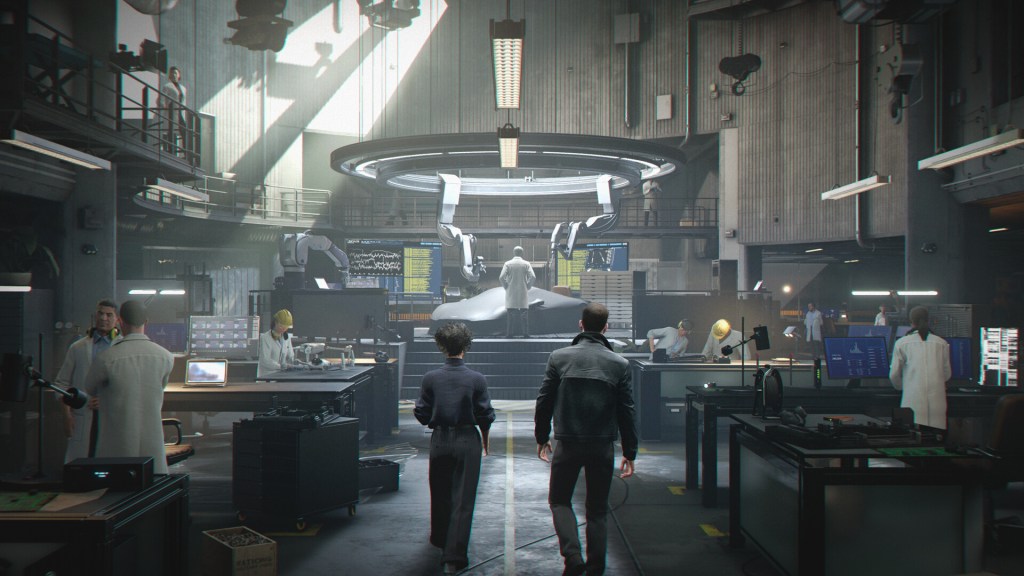
Starting wholesale from scratch gives IO Interactive the chance to fully reimagine its world without the baggage of the Eon movies or Ian Fleming’s novels, to tell its own story. 007 First Light is unafraid of the character’s legacy; we see it all here. Q-Lab is tailored very much in the style of Desmond Llewelyn and less so Ben Whishaw, meaning gadgets are in, but only in the way that serves the core gameplay experience, in aiding the adventure aspects without compromising the gritty, Dalton-esque feel of proceedings.
I expect you to die, Mr. Bond

In other words, 007 First Light fully understands it’s a video game and leans into this fairly often. Early into the experience, you’re handed a Q Watch, and this is your core method for using gadgets and diegetically scanning the environment for traps to set off, enemies to target, and so forth. You’ll need all the help you can get, too, because the difficulty here is considerable. IO Interactive smartly tuned enemy AI to be more accustomed to what you would find in Spec Ops: The Line or F.E.A.R. for how they will destroy your cover, flank your position, and apply suppressive fire; passivity simply isn’t an option.
The shooting of 007 First Light gameplay is exceptional; it ranks among the best third-person shooters that I’ve ever played, particularly on PC with a good mouse and keyboard. As Bond, your back is always against the wall. Enemies are abundant, and ammunition is scarce. It means you must be accurate with scoring headshots, or become adept at disarming your opponents, or shooting them in the legs to disable them. What do you do if you run out of ammo mid-firefight? Simply throw the pistol or rifle at your foe to stagger them, steal their firearm, and finish them off, of course. It’s scrappy and chaotic, but it fits the character’s resolve and resourcefulness well.
This extends to the melee combat, which is unflinching and brutal in the best way possible. Bond is a trained M16 agent, sure, but he’s also just one man. You won’t be seeing Connery-era chops across the back here; instead, you’ll be getting up close and personal with hard-hitting swings and savage takedowns to thin out the ranks. As well as the attacking and countering systems that we’re all familiar with now, one of 007 First Light‘s standout features is that you can grab your enemies, attack them from a clinch, and throw them into the environment, similar to something we’ve seen in Yakuza or Sleeping Dogs. All of these systems culminate in an exciting mix of explosive, improvised action, which is consistently entertaining and engaging.
Shaken, not stirred
007 First Light is an exceptional action game; however, it’s when IO Interactive leans too much on its familiar Hitman trappings that the experience ultimately suffers for it. Throughout the 10 main chapters, there are a few set pieces where Bond will need to investigate the area to keep an eye on a market target. The twisting narrative means you’ll be suspicious of everyone you meet throughout the runtime, but it’s just a shame that, for these instances, we’re essentially given a watered-down (and not very replayable) version of a black box mission.
Whether it’s finding an ID bracelet to access an elevator, keeping up with a suspected rogue agent that’s periodically changing outfits, or hacking a smartphone in the middle of a crowded nightclub, what we’re tasked with is exciting, even if the core experience is less so. Bond can use instinct to bluff his way through situations, and while this is thrilling the first couple of times, it essentially becomes a get-out-of-jail-free card, meaning there are no real consequences to being caught, and the challenge of social stealth can quickly become trivialised.
This is compounded by the fact that you can often use the Q Watch’s laser to blind a watcher right near your target, or shoot a poison dart from your phone to make them ill and instantly step aside, allowing you to waltz right on through. The puzzles in the 007 First Light follow a similar trajectory; they are rarely challenging, and often have the solutions easily light up via the Q Watch’s display, or you can wait a few seconds for Bond to quip to himself about what to do, if an ally doesn’t comment on it already.
That isn’t to say that 007 First Light doesn’t respect and honor player agency; it certainly does, just not to the same extent as the Hitman games. I bring up this comparison chiefly because the game does such a good job of being its own beast that when it falls back on familiar tropes, while removing choice and consequence, it ultimately suffers as a result. I was always more keen on getting back into the action of a car chase or a series of shootouts than I was slowly walking around a crowded room and eavesdropping on all too convenient conversations.
Live and Let Die

As a 20-or-so-hour-long adventure, 007 First Light impresses with a wide vista of locations, colorful characters, and setpieces galore. This is where the game excels, as it tells its story amid the contrasting gameplay styles. We see an inexperienced recruit ultimately become the double-O agent of the series’ namesake, and all the strife associated with it, all unravelling from a single thread. The story sees Bond uncovering a conspiracy against THEIA, an AI quantum computer that’s said to have immaculate accuracy in predicting crimes before they happen.
It’s a story that’s not too detached from our own lives, as AI has taken over so much of what we do in our day-to-day, and it’s not perfect. This is, of course, just a thread that’s pulled as part of a wider narrative, and 007 First Light does well to establish many characters and locations that will, no doubt, reappear in the inevitable sequels to follow. As someone who has seen every Bond film made (even the non-Eon ones like Never Say Never Again), this game ranks among the best narratives and has enough meat on its bones to keep you invested. It does justice for James Bond games, and I’m looking forward to what IO Interactive does with the license in the future, and the first light is certainly a bright one.
FAQs
No. Despite a few small similarities in the more investigation-heavy missions, the new James Bond game has little DNA to share with IO Interactive’s Hitman series.
No, the 007 First Light platforms include the PS5, but also the Xbox Series X/S, PC, and Switch 2.
The 007 First Light release date was May 27, 2026.
The 007 First Light price is the industry-standard $69.99 / £59.99.