I have a genuine dislike of AI stemming from personal, numerical, and anecdotal evidence. To me, it seems everyone who isn’t a high-ranking corporate executive trying to raise their bottom line has a negative opinion on it. This very publication was founded on the idea that generative AI would never be used, which was the very reason I wished to write for it. From blasting through the planet’s water reserves to making millions lose their jobs, AI seems to ruin everything.
That takes us to Nvidia, the world’s most valuable company, clearly in need of more money. It has been making a strong push for AI integration across all platforms, most recently with the announced DLSS 5. This comes at a time when PC components, especially Nvidia-made ones, are so expensive that the average consumer can’t even dream of having a computer powerful enough to utilize them. But besides that, is it even an improvement?
The “AI Filter”
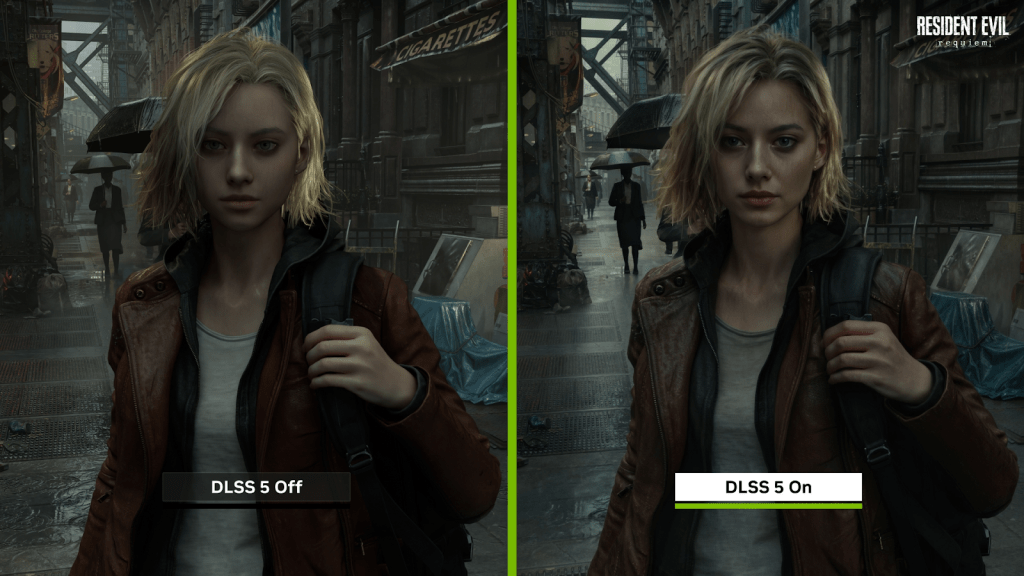
In Nvidia’s DLSS 5 trailer, four different games are used to showcase what DLSS 5 will look like: Resident Evil Requiem, Hogwarts Legacy, Starfield, and the new FIFA. In an attempt to make this look even moderately effective, the trailer consists of very short clips with little fast-paced action. Despite this, even within these few short clips, we can already see the shortcomings of this “innovation”.
They take some time to show us a before-and-after of these games with and without DLSS 5. All of the models shown in the Hogwarts Legacy clips take on this strange sheen when it is activated. On top of this, the actually revolutionary RTX has been snubbed for this AI bastardization, with zero consistency in lighting and style. The models suffer from too much visual noise; however, the worst of all are the Resident Evil examples, which, with this filter, look like an entirely different game.
AI (as much as these companies want you to believe otherwise) really struggles with replicating human faces. This is made worse in low-light environments. To counteract this, it seems the AI has given these characters a strange glow, almost as if they’re emitting an aura. You can see it mostly around characters’ hair and faces, but as I’m sure most will agree, it looks very strange.
The community response
It appears I am not the only one who has taken issue with this. While the phrase “AI slop” gets thrown around, perhaps too often, many in the comments of videos showcasing this technology have aired their grievances. Anything from “Just because we can doesn’t mean we should” and “This is what we sacrificed our ram for?”. Clearly, the average person who plays games has little desire to see this technology utilized.
Which brings me to my final point: who is DLSS 5 actually for? It clearly isn’t for gamers, as mentioned previously. Very few people can afford high-end PCs now, basically exclusively because AI companies are buying up all the necessary components. It shouldn’t be for developers, as who among them would willingly give their hard work to a generative AI model so it could be easily replicated?
It definitely isn’t for artists, as any semblance of originality is destroyed via this tech, making it all blend into an uncanny mess of Play-Doh people. I think it’s for marketing, to justify more of this AI-powered drivel getting forced down our throats, and to give their shareholders a larger bonus while cutting employees. All of this makes me seriously hope this whole launch is one big failure.
FAQs
Nvidia states, “DLSS 5 introduces a real-time neural rendering model that infuses pixels with photoreal lighting and materials.” In simple terms, it uses AI to artificially raise the resolution in real time.
DLSS, invented by Nvidia, stands for Deep Learning Super Sampling and has been in use since the GeForce RTX 20 series. It’s been innovated on with each successive RTX GPU generation.
DLSS 5 was first showcased on March 16, 2026, at Nvidia GTC (GPU Technology Conference). Aside from forcing me to include 3 abbreviations in one sentence, it was not well received by the gaming community, as many say it takes away from the art style of any given project.
At the time of writing, Nvidia is the world’s most valuable company, with a market capitalization of $ 3.35 trillion. If that number were the GDP of a country, it would rank as the 8th-richest in the world, very close to 7th, beating countries like Italy and Russia.